Priamus
Le Morte d'ArthurPriamus is a prince encountered by Sir Gawaine during King Arthur’s campaign against Rome. Their fight becomes a turning point: Priamus asks to embrace Gawaine’s faith, and the former opponents become allies. After their return, King Arthur has him baptized, admits him to the Round Table, and grants him the duchy of Lorraine.
Identity and Introduction
Priamus enters the narrative as a formidable opponent in the Roman war. He is a prince, the son of a powerful father, and claims descent in a direct line from Alexander and Hector; he also names Duke Joshua and Maccabaeus among his lineage. He says he is the rightful heir of Alexandria, Africa, and the out islands. His princely standing is matched by a boastful self-image: he admits that he had been so proud that he thought no man his equal.
The encounter with Gawaine puts that confidence under pressure. The two knights fight until each is wounded, and Priamus recognizes Gawaine’s ability. Yet the meeting becomes more than a contest of strength: Priamus asks Gawaine to tell him who he is, and Gawaine reveals that he is a knight of the Round Table, raised in King Arthur’s household and dubbed by the king. Priamus says this disclosure pleases him more than if Gawaine had given him a province and Paris. He values the honor attached to Gawaine’s identity above material reward.
Combat and Conversion
During their fight, Priamus tells Gawaine that the weapon he carries will cause a wound that cannot be stanched. He offers to stop Gawaine’s bleeding if Gawaine will help him become Christian and believe in God. Gawaine agrees, but first asks who Priamus is and why he is there. Priamus gives his name and lineage, explains that his father has rebelled against Rome and overrun Roman lands, and declares his willingness to accept Gawaine’s faith.
Priamus also warns Gawaine that a much larger force is close by: the Duke of Lorraine, the noblest men of Dauphiné, lords of Lombardy, the garrison of Godard, and Saracens of the Southland, numbering sixty thousand. Priamus says that a hundred knights are waiting nearby for a signal and could capture Gawaine. Despite the danger and their wounds, the pair ride on together to Gawaine’s companions. Priamus then uses a vial of the four waters from Paradise and balm to tend both men; within an hour, they are healed. His immediate practical help gives substance to the alliance formed in the field.
Alliance and Service to Gawaine
The newly allied party faces the prospect of attack by a vastly larger force. Priamus counsels withdrawal, warning that their company numbers fewer than seven hundred and that perilous knights are waiting in the woods. Gawaine argues that it would be shameful to retreat without fighting and urges the party to arm and meet the enemy. Priamus’s caution and Gawaine’s resolve bring different judgments to the same predicament, but Priamus remains with the company rather than returning to his own waiting followers.
When Gawaine brings his company and prisoners back to King Arthur, he explains that Priamus is not a prisoner in the ordinary sense: he has yielded himself to God and to Gawaine, and agreed to become Christian. Gawaine credits Priamus’s help with making their return possible and asks the king to have him baptized, praising him as a noble man and a capable knight. Priamus’s entry into Arthur’s service thus comes through Gawaine’s testimony as well as his own pledge.
Baptism, Rank, and Reward
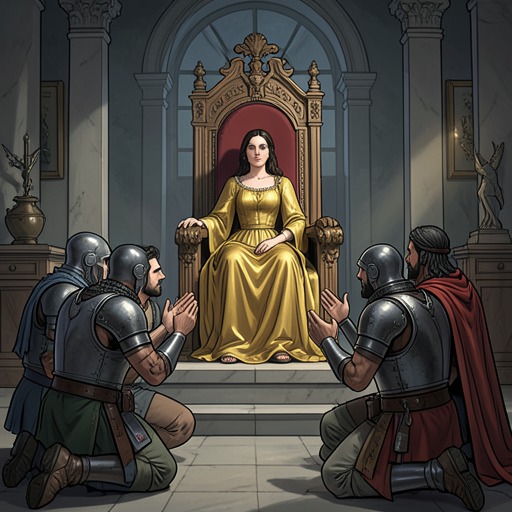
King Arthur has Priamus baptized and retains his original name. He then makes him a duke and a knight of the Round Table. Later, after the campaign’s conquests, Arthur grants Priamus the duchy of Lorraine. Priamus thanks the king and promises to serve him for the rest of his life.
These rewards convert the encounter’s personal bond into a public political relationship. Priamus begins the episode as a prince whose father is at war with Rome and whose own forces are stationed nearby; he ends it as a Christian knight bound to Arthur by service and endowed with a duchy. His place in the story is brief, but the sequence gives his change concrete form: recognition in combat is followed by aid, baptism, admission to the fellowship, and territorial reward.
Narrative Role
Priamus’s episode joins military adventure to conversion and the making of allegiance. Gawaine’s victory does not simply dispose of an enemy: the combat opens a conversation in which each man reveals identity and standing, and Priamus chooses a new religious and political allegiance. The contrast between Priamus’s original pride and his respect for Gawaine’s earned reputation makes recognition—not conquest alone—the hinge of the encounter.
His incorporation into Arthur’s order also shows how the campaign creates relationships beyond the battlefield. A prince connected to Rome’s opponents becomes a baptized Round Table knight and, ultimately, Duke of Lorraine. The narrative presents that shift through acts with public consequences: a promise of faith, Gawaine’s intercession, the king’s ceremony and appointment, and Priamus’s pledge of lifelong service.